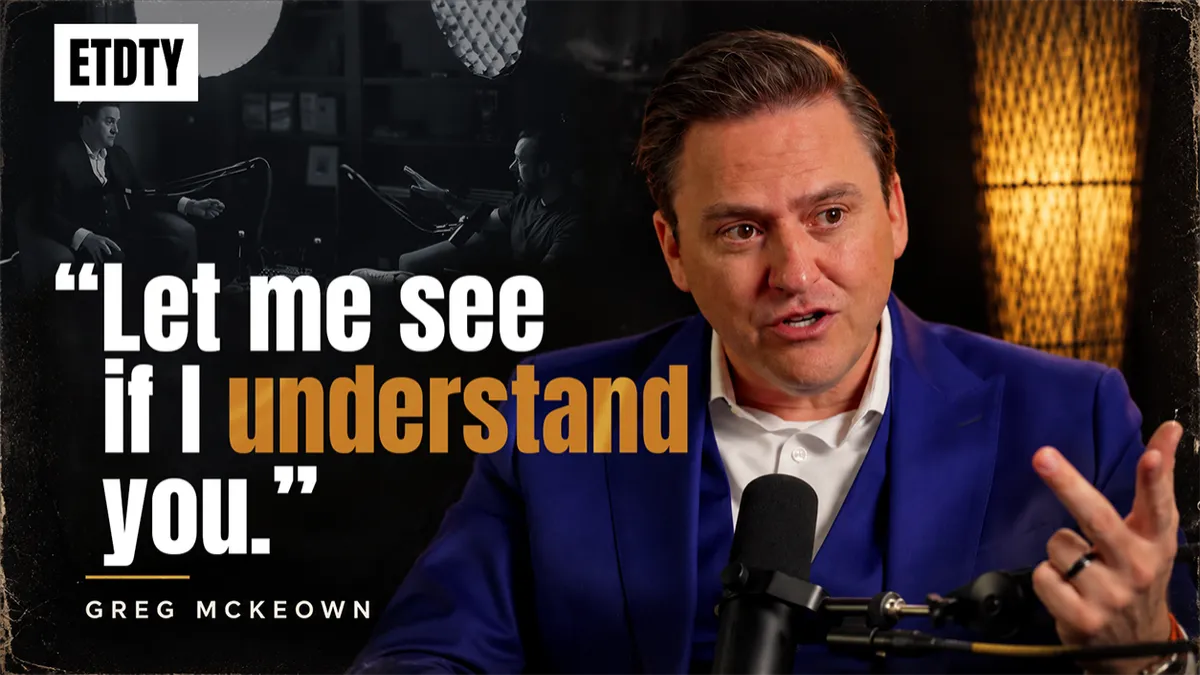
Confident Misunderstanding: A Leadership Challenge
Leadership, Effective Communication, Relationship Building
Confident Misunderstanding: The Silent Threat to Leadership and Communication
Confident Misunderstanding might be the most dangerous communication problem you have never named. Introduced by author Greg McKeown, it describes the moment when two people walk away from a conversation absolutely sure they are aligned—while actually being miles apart. For professionals, this gap between confidence and accuracy quietly erodes leadership, trust, and results.
What Greg McKeown Means by “Confident Misunderstanding”
Greg McKeown, known for his work on Essentialism, uses Confident Misunderstanding to capture a subtle but pervasive reality: we are often most wrong when we are most sure we are right. In conversations, both parties believe they have reached clarity. No one double-checks assumptions. No one slows down to verify meaning. The result is a fragile agreement that feels solid—until it fails in execution.
This is not simple confusion. Confusion is obvious; people ask questions, seek help, and request clarification. Confident Misunderstanding is dangerous precisely because it is invisible in the moment. It sounds like:
“We’re all on the same page, right?”
“Got it. Leave it with me.”
“That’s exactly what I was thinking.”
Each of these phrases can be genuine—or they can be a mask covering unspoken assumptions. When Confident Misunderstanding goes unchecked, it undermines Effective Communication, Leadership Skills, and Relationship Building across an organization.
How Confident Misunderstanding Damages Leadership
Leadership lives or dies on clarity. When leaders assume they have been perfectly understood, they often move too quickly from alignment to action. The team leaves a meeting feeling confident; the leader leaves feeling satisfied. But in the days that follow, work drifts, priorities collide, and deadlines slip. The problem is not effort—it is Confident Misunderstanding at the moment of agreement.
The impact on leadership includes:
Eroded credibility: When leaders repeatedly “change direction,” teams often blame inconsistency, when the root issue was poor mutual understanding from the start.
Misaligned execution: Teams deliver what they thought was requested, not what the leader truly intended, creating rework and frustration.
Silent disengagement: When people feel blamed for missing expectations they never clearly understood, they quietly withdraw initiative and creativity.
The most effective leaders treat clarity as a discipline, not a one-time event. They recognize that Confident Misunderstanding is not a personal flaw—it is a human tendency. Their Leadership Skills include building systems and habits that expose misunderstanding early, before it becomes a costly failure.
The Hidden Cost in Professional and Personal Relationships
Confident Misunderstanding does not stop at the office door. It quietly shapes how we show up in partnerships, friendships, and families. In Relationship Building, we often assume shared meaning based on history, roles, or familiarity: “I know what they meant.” Over time, these unchecked assumptions accumulate into resentment and distance.
Consider a manager giving “constructive feedback” who believes they were supportive and clear. The employee, however, hears criticism and threat. Both leave the conversation confident in their interpretation. The relationship slowly deteriorates—not because of the topic itself, but because the misunderstanding was never surfaced and resolved.
In personal relationships, Confident Misunderstanding often appears as:
“I thought you knew that was important to me.”
“I assumed you were fine with this decision.”
“I didn’t realize you heard it that way.”
Strong relationships are not built on the absence of misunderstanding; they are built on the willingness to name and repair it. Professionals who learn to challenge their own confidence in what they think they heard develop deeper trust and more resilient connections in every area of life.
Understanding Gaps: The Space Between What Was Said and What Was Heard
At the core of Confident Misunderstanding are Understanding Gaps—the subtle distance between the message the speaker intended and the meaning the listener actually constructed. These gaps are shaped by context, culture, experience, and even mood. Two professionals can hear the same words and walk away with entirely different mental pictures of success.
High-performing teams treat Understanding Gaps as inevitable. Instead of pretending they do not exist, they design conversations to reveal them. This looks like:
Asking, “When you say done, what exactly does that include?”
Clarifying, “What will this look like in practice next week?”
Confirming, “Let’s each summarize our understanding to make sure we match.”
💡 Pro Tip: Assume there is always at least a 10% gap between what you meant and what others heard. Design your communication to find and close that gap.
Active Listening: The Antidote to Confident Misunderstanding
If Confident Misunderstanding is fueled by assumption, Active Listening is its opposite. Active Listening is more than nodding along or waiting to speak. It is the disciplined practice of listening to understand, not to respond. For professionals, it is one of the most underused yet powerful Leadership Skills available.
Practical Active Listening behaviors that reduce Confident Misunderstanding include:
Reflecting: “What I’m hearing is that your main concern is the timeline, not the scope. Is that right?”
Clarifying: “When you say ‘high priority,’ how does that compare to the launch project?”
Checking emotion: “It sounds like this change is frustrating. What’s most challenging about it for you?”
These techniques slow down the conversation just enough to surface hidden assumptions. They also signal respect, which strengthens Relationship Building while improving Effective Communication. Over time, teams that normalize Active Listening experience fewer surprises and more aligned execution.
The Signalist Loop: Turning Conversations into Feedback Systems
One powerful way to counter Confident Misunderstanding is to treat every important conversation as a loop, not a one-way broadcast. This is where the idea of the signalist loop becomes essential. In a signalist loop, communication is seen as a continuous exchange of signals and feedback, rather than a single message sent from leader to listener.
In practice, a signalist loop looks like this:
The sender shares a message as clearly as possible, including context and intent.
The receiver reflects back what they understood, in their own words.
The sender listens to the reflection, identifies Understanding Gaps, and refines the message.
Both parties agree on concrete next steps and success criteria, closing the loop.
The signalist loop transforms communication from “I told them” into “We verified mutual understanding.” It is especially valuable for leaders responsible for complex initiatives, cross-functional projects, or sensitive feedback conversations. By designing communication as a loop, you dramatically reduce the risk that Confident Misunderstanding will quietly derail your intentions.
📌 Key Takeaway: If there is no explicit feedback loop, there is almost certainly Confident Misunderstanding. Build the loop on purpose.
Practical Ways Professionals Can Reduce Confident Misunderstanding Today
Turning insight into action starts with small, consistent habits. To strengthen Effective Communication and protect your Leadership Skills and Relationship Building from Confident Misunderstanding, consider these practices:
End key meetings with a round of “Here’s what I’m taking away…” from each participant.
Replace “Any questions?” with “What questions does this raise for you?” to normalize curiosity and clarification.
In one-on-ones, ask, “What did you hear as my top priority for you this week?”
When you feel most certain, pause and ask, “What might I be missing about how this landed with others?”
From Confident Misunderstanding to Confident Clarity
Greg McKeown’s concept of Confident Misunderstanding offers professionals a powerful lens on why good intentions so often produce disappointing outcomes. The problem is not a lack of intelligence or effort; it is the invisible gap between what we think we communicated and what others actually understood. Left unchecked, this gap erodes leadership, weakens relationships, and undermines even the best strategies.
The solution is not to doubt yourself endlessly, but to build structures that replace assumption with verification: Active Listening, explicit Understanding Gaps, and a deliberate signalist loop in every critical conversation. When you do this consistently, confidence and clarity finally move in the same direction. You do not just feel understood—you are.
For modern professionals, this shift is more than a communication technique. It is a leadership mindset: humility in what we think we know, courage to ask better questions, and discipline to close the loop. That is how you move from Confident Misunderstanding to confident, shared understanding—where real progress begins.